Hongnuo (shenyang) General Machinery Co., Ltd. is one of the most reliable manufacturers and suppliers of temperature sensor for corrosive media in China. Welcome to buy high quality temperature sensor for corrosive media at competitive price from our factory. We also accept customized orders.
Products Description
| Parameter | Specification |
|---|---|
| Probe Rod Length: | 0~300 mm, customizable |
| Probe Diameter: | φ3.2, φ4.5, φ5, φ6, Customizable |
| Medium Temperature Range: | -50 ~ +300 °C (-58 ~ 572 °F), customizable |
| Pressure Withstand Capacity: | 3.5 bar |
| Probe Rod Material: | 316L, PTFE |
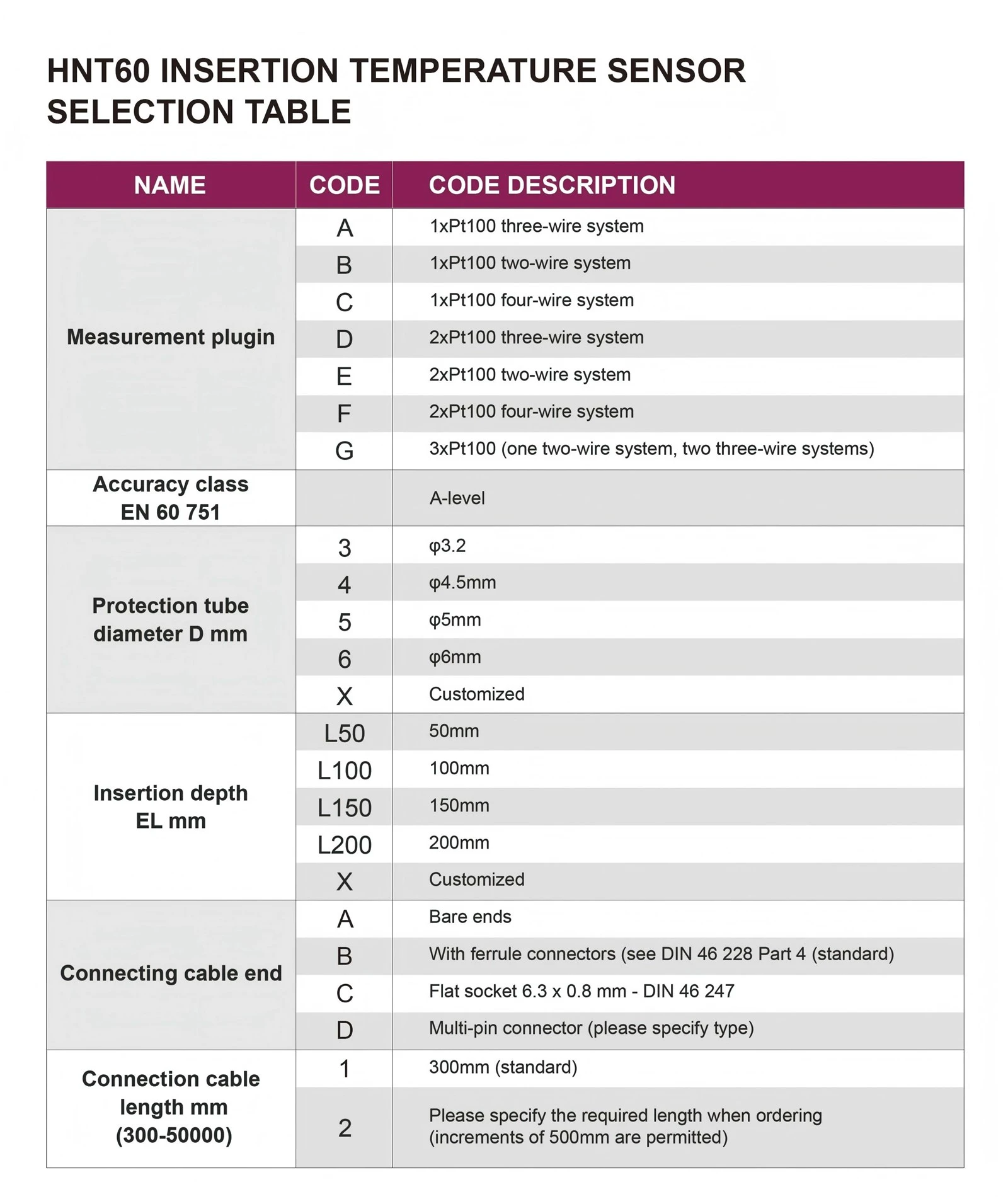
Please see the Specifications for more details.
Typical Applications

Wet Semiconductor Processing
Used for temperature monitoring in chemical baths for processes such as cleaning, etching, and developing. Its fully encapsulated PFA/PTFE design ensures chemical inertness in corrosive media-such as hydrofluoric acid and strong alkalis-preventing contamination of the process bath.
Chemical Supply and Distribution Systems
Installed on chemical transfer lines or inside storage tanks to monitor the process temperature of highly corrosive fluids, such as sulfuric acid and hydrochloric acid. A pressure rating of 3.5 bar is sufficient for most low-pressure chemical piping systems.
Electroplating and Surface Treatment
Temperature control for bath solutions used in copper plating, nickel plating, anodizing, and similar processes. The PTFE sheath resists corrosion from electrolytes, while the small-diameter probe (φ3.2 mm) offers rapid response and allows for easy immersion into the bath.
Why Choose HNT60 ?
Continuous perfluorinated encapsulation process: The key feature is not merely the use of PTFE, but the use of a melt-bonding technique at the transition between the protective sheath and the connecting cable-avoiding threaded or adhesive connections. During thermal cycling (e.g., tank temperatures shifting from ambient to 150°C), differences in the coefficients of thermal expansion between materials do not cause the interface to loosen or crack-a primary cause of failure in corrosion-resistant probes.
Separable Pt100 insert and sheath design: The temperature-sensing insert is an independent component that can be withdrawn from the protective sheath for replacement. In the event of a broken wire or accuracy drift, only the insert needs to be replaced; there is no need to dismantle the entire probe or drain the tank medium, resulting in low maintenance costs and minimal downtime.
Crimp-style ceramic terminal block structure: An internal ceramic terminal block combined with a crimping process prevents fatigue fractures at solder joints caused by prolonged vibration (such as that from agitators). The ceramic material also provides excellent insulation and temperature resistance, ensuring no leakage current between lead wires.
Pressure-resistant sealing structure: The ability to withstand 3.5 bar pressure relies not on a thick-walled sheath, but on a compression seal design between the PFA sheath and the sealing base. Higher medium pressure results in tighter sealing force-a self-tightening sealing principle. Unlike conventional threaded seals that rely on unidirectional compression, this design is better suited for operating conditions involving fluctuating temperatures and pressures.
Key Advantages
- Fully encapsulated in fluoropolymer for genuine corrosion resistance
- Small-diameter probe ensures rapid response and flexible installation
- Class A Pt100 sensing element guarantees high accuracy
- Flexible configuration options: 2-wire, 3-wire, or 4-wire systems
- 3.5 bar pressure rating and IP67 protection suit both process and field environments
- Versatile termination options compatible with various data acquisition systems

| HNT60 Anti-corrosion Temperature Sensor | |
|
Specific Parameters |
Value / Description |
|
Measurement Principle |
Corrosion-resistant insertion-type temperature sensors primarily convert temperature changes into resistance or voltage signals through their internal sensing elements (such as PT100/PT1000 resistance temperature detectors or thermocouples). Due to their insertion structure, the probe tip (encased in corrosion-resistant materials such as PTFE or Teflon) directly penetrates the medium to transfer heat, thereby achieving high-precision, corrosion-resistant on-site temperature measurement. |
|
Application and Industry |
Used in the semiconductor industry and laboratory field, mainly for the measurement of corrosive media |
|
Probe Rod Length |
0~300mm |
|
Protection Tube Diameter |
φ3.2,φ4.5,φ5,φ6,Customizable |
|
Insertion Depth |
50mm,100mm,150mm,200mm,Customizable |
|
Wire End |
Exposed, with cold pressure connector, foil socket or multi-pin connector |
|
Connection Cable |
Polytetrafluoroethylene (PTFE) flame-retardant cable with ambient temperature range of -50~150℃ (optional) |
|
Material Of Protection Tube |
Polytetrafluoroethylene, PFA |
|
Resistance Temperature Detector (RTD) Insert |
Compliant with DIN EN 60 751, Class A, two-wire Pt100 temperature sensor |
|
Pressure Withstand Capacity |
3.5bar |
|
Measure Temperature |
-50 ~ +300 °C (-58 ~ 572 °F), Customizable |
|
Connecting Cable Length |
300mm,Customizable |
|
Material |
316L,PTFE |
|
Accuracy Grade |
Class A |
|
Outputs |
PT100 |
|
Protection Level |
IP67 |
|
Power Supply |
DC 24V |
|
Product Safety |
CE certified |
|
Functional Safety |
Complies with IEC 61508 standard, allowing use in safety applications specified in IEC 61511 standard |